
AAC Blocks
Lightweight Blocks for Modern Construction.

AAC Blocks
Autoclaved Aerated Concrete
Lightweight Wall Construction
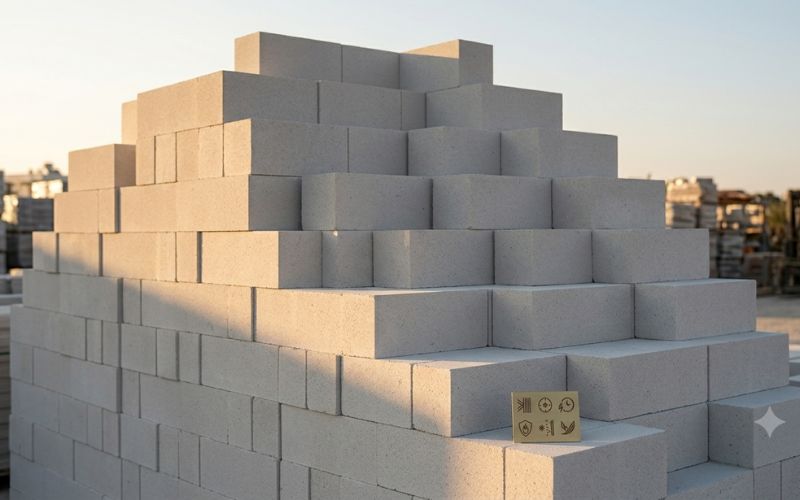
AAC Blocks for Modern Residential and Commercial Projects
KPG supplies Renacon Autoclaved Aerated Concrete (AAC) blocks, a modern building material designed for faster construction with better accuracy and thermal performance. They are a practical alternative to conventional red bricks for residential and commercial projects across India. Renacon AAC blocks are lightweight, fire resistant, and thermally efficient. Their consistent dimensions and superior acoustic insulation make them a reliable choice for builders and contractors who want quality and speed on every project.
Why Choose KPG AAC Blocks
Thermal Insulation
Keeps interiors cooler and reduces overall energy consumption.
Faster Construction
Speeds up the building process compared to conventional bricks.
Dimensional Accuracy
Consistent block size ensures precise and uniform wall construction.
Fire Resistant
Non-combustible material for enhanced building safety.
Acoustic Insulation
Reduces external noise transmission through walls effectively.
Lightweight Build
Lighter than conventional bricks, reducing overall structural load.
FAQ
Product Questions Answered
AAC blocks work well for infill walls, partitions, and non-load-bearing walls in residential, commercial, and high-rise framed structures. They are not recommended for below-ground foundations or heavy load-bearing walls without high-density variants. Specialised fasteners are also needed for fixing heavy fixtures to AAC block walls.
AAC blocks can save up to 20% on total construction costs compared to conventional bricks. Their larger size reduces mortar usage, faster installation cuts labour costs, and their lightweight nature lowers foundation and steel requirements. Long-term energy savings through thermal insulation and lower maintenance add further value over time.
AAC blocks provide an STC rating of 40 to 45 decibels, making them effective for noise reduction in bedrooms, offices, and busy areas. They are non combustible, withstand temperatures up to 1200°C, and offer fire resistance of 2 to 6 hours depending on block thickness, which is significantly better than standard clay bricks.
AAC blocks are up to 50% lighter than clay bricks, which reduces the overall dead load and seismic forces acting on the building during an earthquake. Their porous structure absorbs and dissipates vibrations better than brittle masonry. However, overall seismic safety also depends on proper structural design and reinforcement.
AAC blocks are made using fly ash, an industrial byproduct, reducing landfill waste and avoiding the use of fertile topsoil. Their production consumes less energy than firing clay bricks. Their thermal insulation properties also reduce a building's long-term energy consumption, making them a recognised green building material.
AAC blocks contain millions of tiny air pockets that slow down heat transfer, keeping interiors cooler in summer and warmer in winter. This natural insulation can reduce cooling and heating costs by up to 30%. Their low thermal conductivity means air conditioning systems work less, directly lowering electricity bills.